


IEEE ComSoc Fellow Evaluation Committee (FEC)

The IEEE Fellow grade recognizes the extraordinary contributions and accomplishments of our members in the IEEE fields of interest through the Fellow Recognition Program. Elevation to the grade of IEEE Fellow is one of the highest honors that can be bestowed upon a member of our Society. Only one-tenth of one percent of the IEEE voting membership can be elevated to Fellow each year. The nominees must be approved by the IEEE Board of Directors (BoDs).
The IEEE Communications Society (ComSoc) Fellow Evaluation Committee (FEC) is responsible for the Society’s evaluation of Fellow nominations under consideration by the IEEE Fellow Committee (IEEE FC). The ComSoc FEC conducts and provides IEEE FC with a critical technical evaluation and an assessment of the degree of qualification of the IEEE fellow nominees referred to ComSoc FEC by the nominators, in compliance with the IEEE FC Operations Manual and the ComSoc Policies and Procedures (P&Ps). The FEC completes the evaluation by completing an Evaluation Form for each referred nominee and then forwarding the form to the IEEE FC before the deadline.
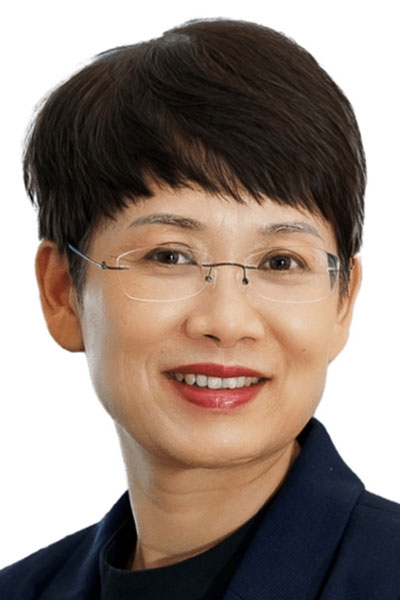
In this issue of the President’s Page, I am pleased to introduce Dr. Sumei Sun, the Chair of the ComSoc FEC, to share with you the details of the fellow evaluation process.
Sumei Sun [F] is a Senior Principal Scientist and the Executive Director at the Institute for Infocomm Research (I2R), Agency for Science, Technology, and Research (A*STAR), Singapore. She also holds a joint appointment with the Singapore Institute of Technology as a full professor and an adjunct appointment with the National University of Singapore as an adjunct full professor. Her current research interests are in next-generation wireless communications, joint sensing-communication-computing-control design, industrial Internet of things, and applied artificial intelligence (AI). Dr. Sun has been a long-term volunteer in ComSoc and served in different roles, including the ComSoc FEC Chair (2022-2025). She is a Fellow of the Academy of Engineering Singapore.
ComSoc FEC Organizational Structure and Roster
The ComSoc FEC’s formation, roster, and term follow the same principles as described in [1]. To manage the workload of the FEC members, the ComSoc FEC 2024 has increased its number of members to twenty-three, out of which a vice-chair is appointed. The FEC appointment is approved by the ComSoc Board of Governors (BoG).
The 2024 FEC roster is given in Table 1. The members’ appointment terms are only indicating the status for 2024 and onward. The roster is also available at the ComSoc FEC website.
| Chair: Sumei Sun (2022-2025) Vice Chair: Murat Uysal (2024-2025) |
| Members: 2024: Romano Fantacci, Peiying Zhu, Ranjan Mallik, Kui Ren, Zhensheng Zhang, Dusit Niyato, Joel Rodrigues, Harald Haas 2024 – 2025: John Thompson, Song Guo, Jennifer Chen, Nada Golmie, Quan Yu, Murat Uysal, Matthew Valenti 2024 – 2026: Lim Teng Joon, Chan-Byoung Chae, Xiuzhen Cheng, Junshan Zhang, Heiner Stüttgen, Ed Tiedelmann, Marco Di Renzo, Carla Fabiana Chiasserini |
| Staff: Bruce Worthman |
Table 1. IEEE ComSoc FEC Roster (2024).
Changes in the Class 2025 IEEE Fellow Nomination
The qualifying requirement for an IEEE Fellow nominee stays the same. The candidate must be an IEEE Senior or Life Senior Member in good standing for a cumulative five years or more preceding 1 January of the year of elevation. For Class 2025, one new category, Standards Contributor (STDC), was added, resulting in a total of five contribution categories in the nomination: Educator (EDU), Research Engineer/Scientist (RE/S), STDC, Technical Leader (TL), and Technology Innovator (TI). TI was formerly referred to as an Application Engineer/Practitioner.
Nominators may include up to two categories for individual contributions by the Nominee.
The nomination needs to describe the nominee’s outstanding contributions in IEEE’s fields of interest, with evidence of impactful work in academia, industry, or government, bringing significant value to society. A nomination must be supported by at least three but no more than five references. Optionally, up to three endorsements can be added. An endorsement will strengthen a nomination if it contains information on specific contributions that qualify the nominee for the IEEE Fellow grade. The nomination form, anonymized reference forms, and endorsement forms will be shared with the IEEE Society/Council (S/C) FEC and, if applicable, the Cohort Fellow Evaluating Committee (CFEC), evaluating the nomination.
The nomination deadline has changed from 1 March 2024 to 7 February 2024 for the Class 2025 nomination. The 7 February deadline applies to Class 2026 nominations as well.
Changes in the Class 2025 IEEE Fellow Evaluation Process
There have been some changes in the evaluation process starting from Class 2025:
- Size of the S/C FEC: To balance the workload of the FEC members, a maximum and a minimum size of the S/C FEC is recommended. The calculation is based on the received nominations to the S/C over the last three nomination cycles;
- Cohort Fellow Evaluation Committee (CFEC): To balance the needs of large/small Societies/Councils, particularly the disparity in nomination pool sizes, seven multi-society/council CFECs are formed, in addition to the seventeen single-society/council cohorts. The cohort will consolidate the ranking of all nominations before submitting them to the IEEE FC.
- For the multi-society/council CFECs, a two-stage evaluation, first in the S/C FEC, then in the CFEC, is implemented; for the single-society/council cohorts, a one-stage evaluation is implemented.
- ComSoc forms its cohort.
- S/C FEC Evaluation: The S/C FEC members evaluate the nominations in the following categories:
- Individual contributions/evidence of technical accomplishment;
- Strength of references/endorsements;
- Professional activities. Each rating category is evaluated separately, and the total score is based on a weighted sum of the category scores.
- IEEE FC Evaluation: In addition to the three categories in the S/C evaluation, the IEEE FC judges also need to evaluate the strength of CFEC (including S/C-FEC) support. Each rating category is assigned a score separately, and the final score is based on a weighted sum of the normalized rankings in each category plus up to 10 points for years of experience.
Fair, Professional, and Transparent Evaluation Process
Coordinated by the FEC Chair, the FEC members perform their duties in a fair and unbiased way. Before the evaluation process starts, the IEEE FC conducts training for all FEC members. The ComSoc FEC Chair also organizes a briefing session with the FEC on the FEC’s evaluation process before the evaluation process commences. As soon as the nominees’ information is received, the FEC Chair organizes the FEC members to complete the conflict of interest (CoI) declaration, upon which the Chair assigns at least five FEC members to each nominee for detailed evaluation. The technical fields and diversity factors are important considerations in the FEC-nominee assignment. For open and fair assessment and discussions subject to the aforementioned exception of CoI, online meetings are organized to go through the evaluation and achieve a consensus on the qualifying category and ranking for all nominees.
All of the documents, information, discussions, debates, voting, and final results associated with the evaluation work are kept strictly confidential by the FEC members and the Chair.
Diversity, Equity, and Inclusion
The IEEE Fellow Program is committed to pursuing diversity in all its operations to help realize and maintain fair nomination and selection processes without bias or discrimination. In November 2023, the IEEE BoD approved the establishment of the FC Diversity Oversight Subcommittee (FC DOS) to promote diversity, equity, and inclusion in the IEEE Fellow selection process, ensuring broader representation across technical fields, regions, and demographics.
In Table 2, the IEEE ComSoc Class 2024 nomination statistics are given in comparison to that of the IEEE.
| Evaluating Society/Council | R1-R7 | R8 | R9 | R10 | Female | Academia |
| ComSoc | 31% | 30% | 0 | 39% | 10% | 79% |
| All | 42.6% | 20.4% | 1.2% | 35.8% | 9.2% | 73.7% |
Table 2. IEEE ComSoc Class 2024 Nomination Statistics.
Table 3 provides the statistics of Class 2024 elevation statistics. Despite the high nomination percentage from Region 10 in ComSoc, the successful elevation is falling behind Regions 1-8. We also see a slightly higher elevation percentage of nominees from academia than the overall percentage, while the percentage of successful women elevation is slightly lower than the overall percentage.
| Evaluating Society/Council | Total | R1-R7 | R8 | R9 | R10 | Female | Academia |
| ComSoc | 33.0% | 35.5% | 36.7% | 0 | 28.2% | 30.0% | 36.7% |
| All | 34.0% | 41.1% | 31.4% | 18.2% | 27.6% | 40.2% | 32.9% |
Table 3. IEEE ComSoc Class 2024 Elevation Statistics.
Observations from the Evaluation Process
- Choosing the right nomination category/categories: A candidate can be nominated in up to two of the five categories: Edu, RE/S, STDC, TL, and TI. The nomination category should be decided based on the nature and characteristics of the nominee’s contributions. It is important for the nominator to choose the right category, articulate the individual technical contributions and the achieved impacts by the Nominee, and provide evidence accordingly. The impact of the Nominee must have already happened, not speculation on potential future impact.
- Citation versus Impacts: As shared in [1], ComSoc FEC takes reference to the Scopus bibliometric indices for a nominee in the RE/S category. However, bibliometric indices should not be the primary evidence of impact and will be weighed against the “typical” citation count in the considered field. The contributions by technologists in the application of engineering, science, and technology shall be accorded equal recognition with theoretical developments.
Closing
Over the years, ComSoc has established best practices and exerted its best efforts to fairly assess and correctly recognize the extraordinary achievements of the Fellow candidates. Nevertheless, it is a challenging task to recognize and assess the accomplishments of so many candidates with extraordinary portfolios. It is a continual process for us to add new learnings and improve our practices. If you have any actionable suggestions for improvement, please contact Dr. Sun. Thank you.
References
- S. Shen and S. Sun, “IEEE ComSoc Fellow Evaluation Committee,” IEEE Commun. Mag., Dec. 2022, pp. 4–5.
This article has been edited for clarity after publication.